Posts tonen met het label ancients. Alle posts tonen

maandag 9 mei 2016

Iron Hans - Jacob and Wilhelm Grimm

Grimm. 136

Iron Hans


Jacob and Wilhelm Grimm

Once upon a time there was a king who had a great forest near his castle, full of all kinds of wild animals. One day he sent out a huntsman to shoot a deer, but the huntsman did not come back again.


"Perhaps he has had an accident," said the king, and the following day he sent out two other huntsmen who were to search for him, but they did not return either. Then on the third day, he summoned all his huntsmen, and said, "Search through the whole forest, and do not give up until you have found all three."

But none of these came home again either, nor were any of the hounds from the pack that they had taken with them ever seen again.

From that time on, no one dared to go into these woods, and they lay there in deep quiet and solitude, and all that one saw from there was an occasional eagle or hawk flying overhead.
This lasted for many years, when an unknown huntsman presented himself to the king seeking a position, and he volunteered to go into the dangerous woods.

The king, however, did not want to give his permission, and said, "It is haunted in there. I am afraid that you will do no better than did the others, and that you will never come out again."
The huntsman answered, "Sir, I will proceed at my own risk. I know nothing of fear."


The huntsman therefore set forth with his dog into the woods. It was not long before the dog picked up a scent and wanted to follow it, but the dog had run only a few steps when it came to a deep pool, and could go no further. Then a naked arm reached out of the water, seized the dog, and pulled it under.

When the huntsman saw that, he went back and got three men. They returned with buckets and baled out the water. When they could see to the bottom, there was a wild man lying there. His body was brown like rusty iron, and his hair hung over his face down to his knees. They bound him with cords and led him away to the castle.

Everyone was greatly astonished at the wild man. The king had him put into an iron cage in his courtyard, forbidding, on pain of death, that the cage door be opened. The queen herself was to safeguard the key.

From this time forth everyone could once again go safely into the woods.
The king had a son of eight years. One day he was playing in the courtyard, and during his game his golden ball fell into the cage.


The boy ran to the cage and said, "Give me my ball."
"Not until you have opened the door for me," answered the man.
"No," said the boy, "I will not do that. The king has forbidden it," and he ran away.
The next day he came again and demanded his ball.

The wild man said, "Open my door," but the boy would not do so.
On the third day the king had ridden out hunting, and the boy went once more and said, "Even if I wanted to, I could not open the door. I do not have the key."

Then the wild man said, "It is under your mother's pillow. You can get it there."


The boy, who wanted to have his ball back, threw all caution to the wind, and got the key. The door opened with difficulty, and the boy pinched his finger. When it was open, the wild man stepped out, gave him the golden ball, and hurried away.


The boy became afraid. He cried out and called after him, "Oh, wild man, do not go away, or I shall get a beating."

The wild man turned around, picked him up, set him on his shoulders, and ran into the woods.
When the king came home he noticed the empty cage and asked the queen how it had happened. She knew nothing about it, and looked for the key, but it was gone. She called the boy, but no one answered.

The king sent out people to look for him in the field, but they did not find him. Then he could easily guess what had happened, and great sorrow ruled at the royal court.

After the wild man had once more reached the dark woods, he set the boy down from his shoulders, and said to him, "You will never again see your father and mother, but I will keep you with me, for you have set me free, and I have compassion for you. If you do what I tell you, it will go well with you. I have enough treasures and gold, more than anyone in the world."

He made a bed of moss for the boy, upon which he fell asleep. The next morning the man took him to a spring and said, "Look, this golden spring is as bright and clear as crystal. You shall sit beside it, and take care that nothing falls into it, otherwise it will be polluted. I shall come every evening to see if you have obeyed my order."

The boy sat down at the edge of the spring, and saw how sometimes a golden fish and sometimes a golden snake appeared from within, and took care that nothing fell into it. As he was thus sitting there, his finger hurt him so fiercely that he involuntarily put it into the water. He quickly pulled it out again, but saw that it was completely covered with gold. However hard he tried to wipe the gold off again, it was to no avail.

That evening Iron Hans came back, looked at the boy, and said, "What has happened to the spring?"
"Nothing, nothing," he answered, holding his finger behind his back, so the man would not be able to see it.

But the man said, "You have dipped your finger into the water. This time I will let it go, but be careful that you do not again let anything else fall in."

Very early the next morning the boy was already sitting by the spring and keeping watch. His finger hurt him again, and he rubbed it across his head. Then unfortunately a hair fell down into the spring. He quickly pulled it out, but it was already completely covered with gold.

Iron Hans came, and already knew what had happened. "You have let a hair fall into the spring," he said. "I will overlook this once more, but if it happens a third time then the spring will be polluted, and you will no longer be able to stay with me."

On the third day the boy sat by the spring and did not move his finger, however much it hurt him. But time passed slowly for him, and he looked at the reflection of his face in the water. While doing this he bent down lower and lower, wanting to look straight into his eyes, when his long hair fell from his shoulders down into the water. He quickly straightened himself up, but all the hair on his head was already covered with gold, and glistened like the sun. You can imagine how frightened the poor boy was. He took his handkerchief and tied it around his head, so that the man would not be able to see his hair.

When the man came, he already knew everything, and said, "Untie the handkerchief."
The golden hair streamed forth, and no excuse that the boy could offer was of any use.


"You have failed the test, and you can stay here no longer. Go out into the world. There you will learn what poverty is. But because you are not bad at heart, and because I mean well by you, I will grant you one thing: If you are ever in need, go into the woods and cry out, 'Iron Hans,' and then I will come and help you. My power is great, greater than you think, and I have more than enough gold and silver."

Then the prince left the woods, and walked by beaten and unbeaten paths on and on until at last he reached a great city. There he looked for work, but he was not able to find any, because he had not learned a trade by which he could make a living. Finally he went to the castle and asked if they would take him in.

The people at court did not at all know how they would be able to use him, but they took a liking to him, and told him to stay. Finally the cook took him into service, saying that he could carry wood and water, and rake up the ashes.

Once when no one else was at hand, the cook ordered him to carry the food to the royal table. Because he did not want them to see his golden hair, he kept his cap on. Nothing like this had ever before happened to the king, and he said, "When you approach the royal table you must take your hat off."

"Oh, sir," he answered, "I cannot. I have an ugly scab on my head."
Then the king summoned the cook and scolded him, asking him how he could take such a boy into his service. The cook was to send him away at once. However, the cook had pity on him, and let him trade places with gardener's boy.

Now the boy had to plant and water the garden, hoe and dig, and put up with the wind and bad weather.

Once in summer when he was working alone in the garden, the day was so hot that he took his hat off so that the air would cool him. As the sun shone on his hair it glistened and sparkled. The rays fell into the princess's bedroom, and she jumped up to see what it was.
She saw the boy and called out to him, "Boy, bring me a bouquet of flowers."

He quickly put on his cap, picked some wildflowers, and tied them together.
As he was climbing the steps with them, the gardener met him and said, "How can you take the princess a bouquet of such common flowers? Quick! Go and get some other ones, and choose only the most beautiful and the rarest ones."

"Oh, no," replied the boy, the wild ones have a stronger scent, and she will like them better."
When he got into the room, the princess said, "Take your cap off. It is not polite to keep it on in my presence."
He again responded, "I cannot do that. I have a scabby head."

She, however, took hold of his cap and pulled it off. His golden hair rolled down onto his shoulders, and it was a magnificent sight. He wanted to run away, but she held him by his arm, and gave him a handful of ducats. He went away with them, but he did not care about the gold.

He took the gold pieces to the gardener, saying, "I am giving these things to your children for them to play with."

The next day the princess called to him again, asking him to bring her a bouquet of wildflowers. When he went in with it, she immediately grabbed at his cap, and wanted to take it away from him, but he held it firmly with both hands. She again gave him a handful of ducats. He did not want to keep them, giving them instead to the gardener for his children to play with. On the third day it was no different. She was not able to take his cap away from him, and he did not want her gold.
Not long afterwards, the country was overrun by war. The king gathered together his people, not knowing whether or not fight back against the enemy, who was more powerful and had a large army.

Then the gardener's boy said, "I am grown up, and I want to go to war as well. Just give me a horse."
The others laughed and said, "After we have left, then look for one by yourself. We will leave one behind for you in the stable."

After they had left, he went into the stable, and led the horse out. It had a lame foot, and it limped higgledy-hop, higgledy-hop.

Nevertheless he mounted it, and rode away into the dark woods. When he came to the edge of the woods, he called "Iron Hans" three times so loudly that it sounded through the trees.

The wild man appeared immediately, and said, "What do you need?"
"I need a strong steed, for I am going to war."
"That you shall have, and even more than you are asking for."

Then the wild man went back into the woods, and before long a stable-boy came out of the woods leading a horse. It was snorting with its nostrils, and could hardly be restrained. Behind them followed a large army of warriors, outfitted with iron armor, and with their swords flashing in the sun.


The youth left his three-legged horse with the stable-boy, mounted the other horse, and rode at the head of the army. When he approached the battlefield, a large number of the king's men had already fallen, and before long the others would have to retreat. Then the youth galloped up with his iron army and attacked the enemies like a storm, beating down all who opposed him. They tried to flee, but the youth was right behind them, and did not stop, until not a single man was left.

However, instead of returning to the king, he led his army on a roundabout way back into the woods, and then called for Iron Hans.
"What do you need?" asked the wild man.
"Take back your steed and your army, and give me my three-legged horse again."

It all happened just as he had requested, and he rode home on his three-legged horse.
When the king returned to his castle, his daughter went to meet him, and congratulated him for his victory.
"I am not the one who earned the victory," he said, "but a strange knight who came to my aid with his army."
The daughter wanted to hear who the strange knight was, but the king did not know, and said, "He pursued the enemy, and I did not see him again."

She asked the gardener where his boy was, but he laughed and said, "He has just come home on his three-legged horse. The others have been making fun of him and shouting, 'Here comes our higgledy-hop back again.' They also asked him, 'Under what hedge have you been lying asleep all this time?' But he said, 'I did better than anyone else. Without me it would have gone badly.' And then they laughed at him all the more."

The king said to his daughter, "I will proclaim a great festival. It shall last for three days, and you shall throw a golden apple. Perhaps the unknown knight will come."

When the festival was announced, the youth went out into the woods and called Iron Hans.
"What do you need?" he asked.
"To catch the princess's golden apple."
"It is as good as done," said Iron Hans. "And further, you shall have a suit of red armor and ride on a spirited chestnut horse."

When the day came, the youth galloped up, took his place among the knights, and was recognized by no one. The princess came forward and threw a golden apple to the knights. He was the only one who caught it, and as soon as he had it, he galloped away.

On the second day Iron Hans had outfitted him as a white knight, and had given him a white horse. Again he was the only one who caught the apple. Without lingering an instant, he galloped away with it.

The king grew angry and said, "That is not allowed. He must appear before me and tell me his name."
He gave the order that if the knight who caught the apple, were to go away again, they should pursue him, and if he would not come back willingly, they were to strike and stab at him.

On the third day, he received from Iron Hans a suit of black armor and a black horse, and he caught the apple again. But when he was galloping away with it, the king's men pursued him, and one of them got so close to him that he wounded the youth's leg with the point of his sword. In spite of this he escaped from them, but his horse jumped so violently that his helmet fell from his head, and they could see that he had golden hair. They rode back and reported everything to the king.
The next day the princess asked the gardener about his boy.

"He is at work in the garden. The strange fellow has been at the festival too. He came home only yesterday evening. And furthermore, he showed my children three golden apples that he had won."
The king had him summoned, and he appeared, again with his cap on his head. But the princess went up to him and took it off. His golden hair fell down over his shoulders, and he was so handsome that everyone was amazed.
"Are you the knight who came to the festival every day, each time in a different color, and who caught the three golden apples?" asked the king.

"Yes," he answered, "and here are the apples," taking them out of his pocket, and returning them to the king. "If you need more proof, you can see the wound that your men gave me when they were chasing me. But I am also the knight who helped you to your victory over your enemies."
"If you can perform deeds like these then you are not a gardener's boy. Tell me, who is your father?"
"My father is a powerful king, and I have as much gold as I might need."
"I can see," said the king, "that I owe you thanks. Can I do anything for you?"
"Yes," he answered. "You can indeed. Give me your daughter for my wife."

The maiden laughed and said, "He does not care much for ceremony, but I already had seen from his golden hair that he was not a gardener's boy," and then she went and kissed him.
His father and mother came to the wedding, and were filled with joy, for they had given up all hope of ever seeing their dear son again.


While they sitting at the wedding feast, the music suddenly stopped, the doors opened, and a proud king came in with a great retinue. He walked up to the youth, embraced him, and said, "I am Iron Hans. I had been transformed into a wild man by a magic spell, but you have broken the spell. All the treasures that I possess shall belong to you."

woensdag 10 juni 2015

Inner worlds, outer worlds


Inner Worlds was created by Canadian film maker, musician and meditation teacher Daniel Schmidt. The film could be described as the external reflection of his own adventures in meditation.
Akasha is the unmanifested, the "nothing" or emptiness which fills the vacuum of space. As Einstein realized, empty space is not really empty. Saints, sages and yogis who have looked within themselves have also realized that within the emptiness is unfathomable power, a web of information or energy which connects all things.
The Spiral. The Pythagorean philosopher Plato hinted enigmatically that there was a golden key that unified all of the mysteries of the universe. The golden key is the intelligence of the logos, the source of the primordial om. One could say that it is the mind of God. The source of this divine symmetry is the greatest mystery of our existence.
The Serpent and the Lotus. The spiral has often been represented by the snake, the downward current, while the bird or blooming lotus flower has represented the upward current or transcendence.The ancient traditions taught that a human being can become a bridge extending from the outer to the inner, from gross to subtle, from the lower chakras to the higher chakras.
Beyond Thinking. Life, liberty and the pursuit of happiness. We live our lives pursuing happiness "out there" as if it is a commodity. We have become slaves to our own desires and craving. Happiness isn't something that can be pursued or purchased like a cheap suit.

donderdag 7 mei 2015

The Art Of War : Chapter 13; The use of spying (Sun Tzŭ )


XIII. THE USE OF SPIES 1.


1. Sun Tzŭ said: Raising a host of a hundred thousand men and marching them great distances entails heavy loss on the people and a drain on the resources of the State. The daily expenditure will amount to a thousand ounces of silver. 2


 There will be commotion at home and abroad, and men will drop down exhausted on the highways. 1

As many as seven hundred thousand families will be impeded in their labour. 2

2. Hostile armies may face each other for years, striving

for the victory which is decided in a single day. This being so, to remain in ignorance of the enemy's condition simply because one grudges the outlay of a hundred ounces of silver in honours and emoluments, 1 is the height of inhumanity. 2


3. One who acts thus is no leader of men, no present help to his sovereign, 3 no master of victory. 4


p. 163
4. Thus, what enables the wise sovereign and the good general to strike and conquer, and achieve things beyond the reach of ordinary men, is foreknowledge1

5. Now this foreknowledge cannot be elicited from spirits; 2 it cannot be obtained inductively from experience, 3 nor by any deductive calculation. 4


6. Knowledge of the enemy's dispositions can only be obtained from other men. 5


7. Hence the use of spies, of whom there are five classes: (1) Local spies; (2) inward spies; (3) converted spies; (4) doomed spies; (5) surviving spies.
8. When these five kinds of spy are all at work, none can discover the secret system. 1 This is called 2 "divine manipulation of the threads." 3 It is the sovereign's most precious faculty. 4


9. Having local spies 5 means employing the services of the inhabitants of a district. 6


10. Having inward spies, making use of officials of the enemy. 1


11. Having converted spies, getting hold of the enemy's spies and using them for our own purposes. 1

12. Having doomed spies, doing certain things openly for purposes of deception, and allowing our own spies to know of them and report them to the enemy. 1


13. Surviving spies, finally, are those who bring back news from the enemy's camp. 2


14. Hence it is that with none in the whole army are more intimate relations to be maintained than with spies. 1

 None should be more liberally rewarded. 1 In no other business should greater secrecy be preserved. 2


15. Spies cannot be usefully employed 3 without a certain intuitive sagacity. 4


16. They cannot be properly managed without benevolence and straightforwardness. 1

17. Without subtle ingenuity of mind, one cannot make certain of the truth of their reports. 2

18. Be subtle! be subtle! 3 and use your spies for every kind of business.

19. If a secret piece of news is divulged by a spy before the time is ripe, he must be put to death together with the man to whom the secret was told. 4


20. Whether the object be to crush an army, to storm a city, or to assassinate an individual, it is always necessary to begin by finding out the names of the attendants, 1 the aides-de-camp, 2 the door-keepers and sentries 3 of the general in command. 4 Our spies must be commissioned to ascertain these. 5


21. The enemy's spies who have come to spy on us must be sought out, 1 tempted with bribes, led away and comfortably housed. 2 Thus they will become converted spies and available for our service.


22. It is through the information brought by the converted spy that we are able to acquire and employ local and inward spies. 3

23. It is owing to his information, again, that we can cause the doomed spy to carry false tidings to the enemy. 4

24. Lastly, it is by his information that the surviving spy can be used on appointed occasions. 5

 
25. The end and aim of spying in all its five varieties is knowledge of the enemy; 1 and this knowledge can only be derived, in the first instance, from the converted spy. 2 Hence it is essential that the converted spy be treated with the utmost liberality.


26. Of old, the rise of the Yin dynasty 3 was due to I Chih 4


who had served under the Hsia. Likewise, the rise of the Chou dynasty was due to Lü Ya 1 who had served under the Yin. 2


27. Hence it is only the enlightened ruler and the wise general who will use the highest intelligence of the army for purposes of spying, 3
 
and thereby they achieve great results. 1 Spies are a most important element in war, because on them depends an army's ability to move. 2

dinsdag 19 juni 2012

Sun Tsu - The Art of War

The Art of War is an ancient Chinese military treatise that is attributed to Sun Tzu (also referred to as "Sunzi" and "Sun Wu"), a high ranking military general and strategist during the late Spring and Autumn period (some scholars believe that the Art of War was not completed until the subsequent Warring States period). Composed of 13 chapters, each of which is devoted to one aspect of warfare, it is said to be the definitive work on military strategies and tactics of its time, and is still read for its military insights.

The Art of War is one of the oldest and most successful books on military strategy in the world. It has been the most famous and influential of China's Seven Military Classics: "for the last two thousand years it remained the most important military treatise in Asia, where even the common people knew it by name." It has had an influence on Eastern military thinking, business tactics, and beyond.


documentary :


The audiobook:

Miyamoto Musashi : the book of the 5 rings

Miyamoto Musashi (宮本 武蔵?, c. 1584 -- June 13, 1645), also known as Shinmen Takezō, Miyamoto Bennosuke or, by his Buddhist name, Niten Dōraku,[1] was a Japanese swordsman and rōnin. Musashi, as he was often simply known, became renowned through stories of his excellent swordsmanship in numerous duels, even from a very young age. He was the founder of the Hyōhō Niten Ichi-ryū or Niten-ryū style of swordsmanship and the author of The Book of Five Rings (五輪書 Go Rin No Sho?), a book on strategy, tactics, and philosophy that is still studied today. Miyamoto Musashi is widely considered as a Kensei and one of the greatest warriors of all time,


Photo: What is called the spirit of the void is where there is nothing. It is not included in man's knowledge. Of course the void is nothingness. 

By knowing things that exist, you can know that which does not exist. That is the void.

People in this world look at things mistakenly, and think that what they do not understand must be the void. This is not the true void. It is bewilderment.

When your spirit is not in the least clouded, when the clouds of bewilderment clear away, there is the true void.

-Miyamoto Musashi-

"What is called the spirit of the void is where there is nothing. It is not included in man's knowledge. Of course the void is nothingness. 

By knowing things that exist, you can know that which does not exist. That is the void.

People in this world look at things mistakenly, and think that what they do not understand must be the void. This is not the true void. It is bewilderment.

When your spirit is not in the least clouded, when the clouds of bewilderment clear away, there is the true void."

-Miyamoto Musashi-
The audiobook: 


Samurai - Miyamoto Musashi Documentary (Mark Dacascos):


Pre-Vedic India Knew About DNA: Indore Scholar


Ancient DNA
© Daily Bhaskar
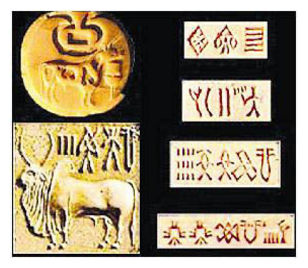
An Indore-based Vedic scholar has claimed that the DNA (Deoxyribonucleic Acid) is not a recent invention of the West but an ancient science traceable in the vestiges of the Mohanjo- Daro of Indus valley civilization. Author of four books on Vedic literature, Dr CP Trivedi has in his latest book claimed presence of DNA science in Vedas. The book "Vedic science vis-a-vis modernscience" is going to be published soon. 


"I am proud to claim that DNA was first discovered in India more than 18000 years ago. Its description is in the Vedas and figures are on the seals excavated from the Indus valley", avers Dr Trivedi. 


Accepted theory about the DNA is that it was first isolated by Swiss physician Friedrich Miescher in 1869. Its double helix structure was first revealed by Watson and Crick in 1953 which is the acceptable structure till date.Dr Trivedi claims that the evidence of the discovery of DNA and the cell division process are visible in the archeological seals and stones of the Mohenjo and Daro settlements. 


"The DNA was termed as Tvashta and Vivasvat in Vedas. Its pictorial representation is visible on the seals of the Indus Valley civilization," says Dr Trivedi.According to the scholar, group of tiny seals expresses evolution of the creation from pre-cosmic condition to evolution of man symbolically in chronological order. The pictorial representation on the seals is akin to the detailed structure of DNA and the gene transfer process as depicted in the modern day science, he says. 


Dr Trivedi earlier wrote to the prime minister office about his claims on DNA. "The PMO forwarded my request to the department of culture, Government of India. But nothing has happened since then," he rues. Dr Trivedi has presented several papers on evidence of DNA in Vedic interpretations abroad. "I recently presented my paper in Athens and my findings received great appreciation there," said Dr Trivedi. 


http://www.sott.net/articles/show/246807-Pre-Vedic-India-Knew-About-DNA-Indore-Scholar

donderdag 19 april 2012

Calendar Reform and the Future of Civilization


Preparatory Reflections for
the World Summit on Peace and Time
University for Peace, Costa Rica,
Crystal Moon 24-Cosmic Moon 1, Sixth Year of Prophecy
(Gregorian June 22-27, 1999)

Part 1

The purpose of the World Summit on Peace and Time is unprecedented. It is nothing less than to formulate and propose with distinct and concrete steps a reform of the current world standard of daily time keeping, the twelve-month Gregorian calendar, replacing it instead with a perpetual calendar of thirteen months of 28 days each. This step is taken with the utmost seriousness of intention and a recognition of the profound and wide-ranging implications which such a reform promises. To replace the current calendar with an entirely different standard of measure is to undertake a fundamental change that reaches to the foundations of everything we now call civilization. It is precisely because of the profound changes it augurs that this calendar reform is also undertaken as an act of bringing about universal peace on Earth. Hence, the World Summit on Peace and Time.
Calendar Reform is the final act of history, and the first step toward Earth Regeneration in the cradle of galactic culture. To change the calendar now is to change the course of history and to revolutionize altogether the future of civilization on Earth. In making these sweeping but accurate statements we would be remiss if we did not present a brief history of modern calendar reform so that we may be able to better grasp the subtleties and far-reaching implications of such reform. We must also understand that the timing of this calendar reform is of a vital nature and presents an evolutionary opportunity for humanity which it cannot afford to lose.
The topic of calendars and calendar reform is not a popular one for the simple reason that the calendar in use functions as a dogma and, therefore, there appears little reason to question it. Most people do not have any idea where the current calendar came from. People who live in mostly non-Western societies function with what is called a lunar calendar, as well as the more recent Gregorian calendar. The lunar calendars also dogmatize the sense of time. Though we speak of the Arab, Hebrew, or Chinese lunar calendars, for example, it should be kept in mind that there is only one moon and hence all lunar calendars are actually the same measure. The lunar calendars in use measure the synodic cycle of the moon, from new moon to new moon. This is a cycle of some 29 and one half days. Twelve of these synodic lunations take 354 days, 11 days short of the solar orbit of the Earth. The sidereal cycle of the moon, the measure of the moon from the same place it appears in the sky, is only 27 and one half days. Between the synodic and the sidereal measures, is the mean lunar cycle of 28 days.
While the lunar calendars in use by different world cultures are in no way solar calendars, or a measure of the Earth’s solar orbit, the Gregorian calendar in use today is an approximation of a solar calendar. We say approximation because on the one hand, while the Gregorian calendar accounts for the 365-day solar cycle, inclusive of an extra day every four years, its standard of measure is irregular and corresponds to no natural cycle whatsoever.
It must be unequivocally understood that an irregular standard of measure has a profound effect on the mind, especially an irregular standard of measure of time. This is because time is a mentally perceived phenomenon unlike space which is perceived through the senses. A standard of measure which is irregular and uneven is inherently problematic. Our sense of time is a fundamental perception. If the standard of measure of time that we use is irregular, then we must contemplate deeply and understand what this does to our mind over centuries of prolonged use.

Part 2

If the clock represents the mechanization of time, the Gregorian calendar is the instrument which normalizes the mechanization of time as a mental institution inseparable from the irrational irregularities of its monthly count. In this way modern human civilization has acquired its quality of institutionalized machine efficiency inseparable from a host of irrational social problems, crime and war. Aside from the Vatican itself which preceded and sponsored the Gregorian calendar Reform, virtually all of the inventions, nation states, and institutions of the modern world are incorporated in this calendar. Any attempt to reform the current civil calendar must come to terms with everything that is incorporated in this calendar.
Some 200 years after the Gregorian Calendar Reform came the French Revolution, and the call for a new calendar. The Republican Calendar of 1793 replaced the Gregorian calendar with a twelve-month schedule of 30 days each, plus a five-day period at the end of the year. The French Republican calendar was essentially the same as a Babylonian type which had the same way of dividing the year into twelve 30-day months with a five-day purification cycle at the end. Every four years, this five-day period of the French Republican calendar was extended to six days to account for the quarter day. The seven-day week was replaced by the decalogue or ten-day cycle. The French Republican Calendar lasted ten years, until 1803, when it was replaced by the Gregorian calendar once again.
The anti-ecclesiastical, pro-rationalist sentiment which animated the French Republican Calendar was also behind the proposed calendar reform of the nineteenth century French thinker, Auguste Comte (1798-1857). Best known as the founder of the modern discipline of sociology, philosopher and mathematician, Auguste Comte had the opportunity in the 1840s of learning about a calendar of thirteen months of 28 days each. This information came from travelers who had been to Tahiti where this calendar was well known among the Polynesians. This universal indigenous calendar, timed to the menstrual cycle of woman, so impressed Comte by its harmonic form and biological truthfulness that he devoted several years to studying it before he finalized its form as the Positivist Calendar presented at an 1849 session of the Positivist Society.
Apart from Comte’s proposal for a thirteen month calendar, which of necessity, observes an extra day out of time, the call for Calendar Reform continued in France and elsewhere in Europe, but with a focus on maintaining a twelve month cycle and the seven day week. During the 1890’s, there was considerable agitation for a new calendar to begin the 20th century. In 1900, a conference was organized in Eisenach, Germany, for the study of the Reform of the Gregorian calendar. Throughout these efforts the Papal response was always very intense in the defense of the current calendar for liturgical reasons. But a further defense put forth by the Vatican was that any calendar reform had to respect the succession of the seven-day week. This argument of the Vatican very much restricts or even deadlocks the debate on calendar reform and essentially functions as a “catch 22” which says, “Yes, you can reform the calendar, but only so long as there is no break in the succession of the seven-day week and that there are twelve months.” Anyone skilled at problem-solving will see that these guidelines very much limit the possibilities of calendar reform, and in fact, have been the cause of a lack of success of every effort at calendar reform in the past 150 years. Indeed, all that this argument really amounts to is an expression of the power of the Catholic Church to maintain its calendar as the world standard.
This notwithstanding, it is of great interest that the thirteen moon Positivist calendar of Comte, originally derived from the indigenous Polynesians of Tahiti, figured again in the Pan American Scientific Congress, held in Santiago, Chile, December 25, 1908 - January 5 1909. At this seminal event, a Peruvian by the name of Carlos A. Hesse, introduced a calendar reform using a thirteen month calendar identical to that of Auguste Comte. While we cannot say exactly where Hesse derived his calendar, being from Peru, it is highly likely that he knew that the Andean civilization (conquered by the Europeans) possessed a thirteen moon calendar, as did the Tahitians. Still in use today, the Peruvian thirteen moon calendar is correlated to the 500-year Pachacuti Cycles, and is currently (Gregorian AD 1998-99) in its eleventh Pachacuti cycle, year 5506.
The logical nature of the thirteen month calendar attracted English Railroad magnate, Moses B. Cotsworth, who formed the League of the International Fixed Calendar. In 1921, the International Chamber of Commerce in London, England, decided to promote the calendar world-wide, and the matter was taken to the League of Nations. During the 1920s, Cotsworth attracted the interest of George Eastman of Eastman Kodak, who organized a great campaign on behalf of the International Perpetual Calendar. At the League of Nations a committee to study the topic of calendar reform received numerous proposals, but by far and away the most popular was the International Perpetual Calendar. In the United States alone, over one hundred industries of a great diversity of interests were ready to adopt the thirteen month perpetual calendar. The League of Nations determined that January 1, 1933, would be the date to commence with the new calendar, since that year began on a Sunday, and the perpetual calendar always begins on a Sunday and ends on a Saturday.
While maintaining a close tie with the traditional names of the months of the Gregorian calendar, the thirteenth month being called Tricember, the opposition to the calendar was mounted against the “null day” between the last Saturday of one year and the first Sunday of the next year. This is because 13 x 28 = 364 days, or 52 perfect weeks, (which is what attracted the accountants of industry) and the solar year counts 365 days. Despite the sheer self-existing perfection of form of the thirteen month calendar, resistance to it focused on a great campaign against the unique “null day,” the very point by which it maintained its perpetual perfection. Here the inertia of institutionalized ignorance and disharmony were able to put a stop to this otherwise most successful effort at calendar reform.
In 1931, the 111 delegates representing the 42 member states of the League of Nations listened to the 28 pages of the Report of the Preparatory Commission. While many countries including the United States, Brazil, France, Switzerland and Germany voted in favor of the thirteen month calendar, Hungary, Italy and the Netherlands voiced opposition to the institution of a perpetual calendar which implied the introduction of “supplementary” days (the null day).
Support for this antagonistic position grew with the objection of various astronomers, such as Federico Oom of the Astronomical Observatory of Lisbon and Pope Pius XI, who argued that the break in the succession of the seven-day week would create chaos and calamity. The Pope further argued that the matter of fixing the date of Easter was exclusively under his jurisdiction. This position was further supported by editorials in leading newspapers such as the London Times, October 13, 1931, which argued in favor of the religious scruples, and the New York Times, December 16, 1934, which echoed the reasoning concerning the damage to be done by breaking the weekly succession, a succession which, it was argued, had not been broken since the most ancient Biblical times.
Perceived as an attack on religion and the succession of the week, despite the great amount of money spent on the campaign to promote the thirteen month calendar, the project floundered and could not withstand the conservative sentiments of the Church, certain scientists, and leading periodicals. Supported by a counter-insurgency of various organizations wishing to create an atmosphere favorable to the abolition of the Gregorian calendar, a final effort was made in favor of a moderated twelve-month calendar to occur on Sunday, January 1, 1939. However, this calendar also contained the notorious “null day,” and, on September, 4, 1937, the Committee of Communications of the Society of Nations, Geneva, arrived at the conclusion that the time had not yet come to reform the calendar. In 1950, Pope Pius XII issued a pronouncement that the Church was not opposed to calendar reform, but was opposed to those proposals that included “universal days” which are not days of the seven-day week. This sentiment is echoed in the 1962 declaration of Calendar Reform at the conclusion to the Vatican II Ecumenical Council. As of the middle of the 20th century, the Gregorian calendar prevailed world-wide.

Part 3

The debate on calendar reform as it had occurred up to the Second World War reflects a total immersion in the lens of the Western (Gregorian) mind. The argument that calendar change is a threat to religion is posed only by the religion whose calendar is the object of the calendar reform debate. That the accident of history placed the Vatican’s calendar as the world standard only hardened the position of its defenders. That the principle objection to the calendar reform was the inclusion of a day outside of the weekly cycle (hence assuring four equal quarters of 91 days or thirteen seven-day weeks each) is astonishing in light of the harmonic regularity that would be obtained by such a reform.
The very notion of an unbroken succession of seven-day weeks since the beginning of creation is actually a profoundly linear conception of time. The argument that a break in this succession would cause worldwide chaos, barbarism and the decline of religion, pales when one contemplates the actual course of events since the Second World War or even during the entire 20th century: never has there been more war, more violent death, and the proliferation of more weapons of mass destruction than at any other time in history. Could this be because the human populace is in the grip of a calendar whose actual measure defies harmony and whose proponents have safeguarded its reform by regulations which defy the possibility of any real reform?
In 1956, the Economic and Social Council of the United Nations adjourned debate on the matter of calendar reform indefinitely. The cumulative inertia of the dogma of the Gregorian calendar held sway, and with it, the dominance of the civilization which had grown up in its shadow. We must assert that the concept of an unbroken succession of the weekly cycle is a Western provincialism. The notion of the seven-day week is not shared by the calendars of many other civilizations and cultures. Are we to say that the only true way is that of the seven-day week in unbroken succession as maintained by the Gregorian calendar? No, for this would be to fall into a type of chauvinism and imperialism by which the Gregorian calendar came into prominence in the first place.
While the debate on reform of the Gregorian calendar, the world’s civil calendar, had fallen dormant, the problems of the Cold War only increased, compounded by the unimpeded path of global industrialization. The result was not only the escalation of nuclear terror, but the negative effect of unbridled industrialism on the global environment. In such a complexity of social and technological forces, calendar reform seemed remote and irrelevant.
In 1987, a book called the Mayan Factor was published. For the first time a comprehensive effort had been made to understand the system of thought produced by the ancient Maya of Central America which was focused on a calendrical mathematics and astronomy that was unique to the history of the Earth. By the process of history, this book could only have been produced when it was, for only by this time was enough known of the ancient and contemporary indigenous Maya.
The later Maya civilization was crushed by the Spaniards in the sixteenth century. In 1562, a Catholic priest, Bishop de Landa, burned all the books he could find, and smashed as many sculptures and works of art as he could, while he had the great pyramid temples of the Mayan pilgrimage center of Izamal taken down stone by stone to be reused for the construction of Christian churches and cathedrals. The auto-da-fe of Bishop de Landa caused him to be called back to Europe to report to his superiors. In 1572, the very year Gregory XIII came to power and called for the Calendar Reform ten years hence, Bishop de Landa published his book on the knowledge of the Maya whom he had either destroyed or converted. Apart from Bishop de Landa’s book, knowledge of the ancient Maya was now left to time and the jungle, awaiting “discovery” centuries later by teams of archeologists who would try to piece together the forgotten story.
While the Mayan Factor accounts for the persistence of modern Maya survivors known as “day keepers,” who continue work with the Tzolkin or sacred 260-day calendar, the author, Dr. José Argüelles, plunged into mathematical and historical analyses based on the Tzolkin, which demonstrated it to be more than “just a calendar.” What the Mayan Factor really pointed to is the elaboration of a point of view about time and the existence of a calendar or actually, system of calendars, totally apart from either the Gregorian calendar or the lunar calendars of the Old World. Indeed, according to a contemporary Mayan thinker and ceremonialist, Hunbatz Men, the Maya actually operated with at least seventeen calendars in the prime of their civilization, thirteen hundred years ago. Ironically, at Kitt Peak Observatory, outside of Tucson, Arizona, where the Vatican has its astronomical observatory, there is a mosaic mural of the Maya civilization with a statement asserting that the Mayan calendar was more accurate and scientific even than the Gregorian calendar!
Two years after the publication of the Mayan Factor, the author and his wife, who had long since begun an experiment living according to the cycles of the Mayan calendar rather than the Gregorian, found themselves in the Museum of Time, Geneva, Switzerland. Because of their immersion in another, “outside” view of time, the Argüelles were able to make an astonishing discovery which was to profoundly affect the course of calendar reform. This was the discovery of the 12:60 and 13:20 timing frequencies, the basis of what they later came to call the Law of Time.
What the Argüelles saw in the Museum of Time was actually the history of the mechanization of time. Incorporated into the Gregorian calendar, which had the same historical root in the metric division of space as the mechanical clock, the combination of mechanical clock and irregular calendar had produced an artificial timing frequency whose unconscious acceptance by and grip of the human mind had caused the human species to deviate farther and farther from the cycles of nature. This timing frequency the Argüelles identified as the 12:60, in contrast to what they now knew was the natural timing frequency, 13:20. This 13:20 frequency is derived from the Tzolkin, which they also referred to as the harmonic module, a permutation matrix of 13 x 20 = 260 units. The singular nature of the use and proliferation of so many calendars by the ancient Maya they now understood to be the result of the Maya knowing the actual timing frequency of the universe, 13:20, something consciously unknown to all other people’s of the Earth.
From their discovery, the Argüelles immediately perceived that the cause of the human imbalance with the environment, the reason for the proliferation of industry and new technologies, and the human population “bomb,” were all one and the same: the adoption to and acceptance of a timing frequency at deviance with the laws of nature.
Knowing nothing whatsoever about the earlier efforts at calendar reform, the Argüelles’ first conclusion drawn from their discovery of the 12:60-13:20 timing frequencies was to change the calendar. Instinctively they knew that the thirteen month 28 day calendar was the appropriate solution, as well as the first step to be taken by the human race to conform again to the natural cycles and thus, save itself and its biosphere from destruction. From their knowledge of the different Mayan calendars they also knew that the Maya possessed a thirteen moon calendar, the Tun Uc or Moon count. Following the Chilam Balam prophetic tradition of the Maya, and in accord with the heliacal rising of Sirius, the synchronization or New Year’s date of the new calendar was set at July 26. July 25, therefore became the Day-Out-of-Time (same as “null day”), which the Argüelles’ also referred to as galactic freedom day or Green Day, and which was for the purpose of forgiving debts and sins and wiping the slate clean. The Argüelles also perceived that while in the 12:60 system “time is money,” in the 13:20 system, “time is art.”
With the Thirteen Moon calendar as the basis of their investigation of the Law of Time, the Argüelles forged ahead creating a “tool kit” of the new time called Dreamspell, the Journey of Timeship Earth 2013 (1991). Already a whole systems thinker, Argüelles had identified the unique Mayan vigesimal mathematical system with the mathematics of the fourth dimension, the cause of a radical revisioning of the modern physics of time. In his study of the relation of the human within its environment, Argüelles came to study the works of the Russian biospheric scientist, Vladimir Vernadsky (1863-1945). It was in Vernadsky’s final work, Problems in Biogeochemistry II (1944) that Argüelles found what he was looking for: a statement confirming Argüelles’ perception that modern (Gregorian) science had totally misperceived the nature of time by applying the metrics of space as measurements of time, thereby obscuring altogether the actual nature of time. In other words, time is a dimension totally apart from, or grater than space, and, according to Vernadsky, from the point of view of time space is an infinitely locatable point.
On this basis Argüelles was able to write “A Treatise on Time Viewed from its own Dimension” (published as The Call of Pacal Votan, 1996). The conclusion to this text considers what Vernadsky calls the biosphere-noosphere transition from the perspective of the analysis of the fourth-dimensional timing standards. According to this analysis, the contemporary human Earth civilization is already in the midst of this transition which augurs a radical shift in operations and evolutionary advance into what Vernadsky calls the “Psychozoic Era.” Argüelles was convinced that the Thirteen Moon calendar change was the most intelligent and only peaceful way for humanity to change its frequency and participate positively in this climactic evolutionary change.
The Argüelles also perceived that due to the unconscious mental effects of the Gregorian calendar, the contradictions inherent in global society are greater than the capacity for their resolution, while the problems created for the environment are far greater than nature’s capacity to restore and regenerate itself. Something dramatic had to happen. In his continuing efforts at decoding the ancient Mayan hieroglyph, on July 26, 1993, something dramatic happened to Argüelles. He began decoding the stone sarcophagus of the tomb of Pacal Votan (603-683) of Palenque, and was thunderstruck by the prophecy of the Thirteen Moons. This prophecy is known as the Telektonon and states succinctly: “Telektonon is revealed to you, God’s plan for peace on Earth, the last and only hope for spiritual renewal and salvation: immediate acceptance and adoption of the 28-day, thirteen moon way, the calendar Telektonon.” From this was born the World Thirteen Moon calendar Change Peace Movement.

Part 4

The Telektonon establishes the period between July 26, 1993, and July 25, 2000, as the “seven years of prophecy.” During the first five years of this time the Argüelles traveled throughout Latin America, Europe, the Far East and North America to spread the message of the Thirteen Moon calendar and arouse a world peace movement. The essence of their mission is summarized as the Thirteen Moon calendar Change Peace Plan (1995), the crux of which says that if there is to be a calendar change, then the world must come to a halt to observe the change. Stopping the world to observe the change is the pretext to call for a universal cease fire and implement strategies to alleviate the problems now locked into the old civil calendar. Through their efforts they convened First Planetary Congress of Biospheric Rights, Brazil, 1996, and the World Congress on the Law of Time and Judgement Day Tribunal, Japan, 1997.
The essence of the Judgement Day Tribunal was to bring to light the role the Vatican and its calendar had played in the creation and maintenance of the present world order. For this reason, and still with but scant knowledge of prior calendar reform efforts, the Argüelles mounted a diplomatic campaign to enlist the Vatican and the United Nations in their efforts to change the calendar. Arriving in Rome on January 1, 1998, with a legal team from Brazil, the Argüelles hoped to reach Pope John Paul II with their proposal. A meeting with one of the Pope’s private secretaries convinced them that they also needed the support of the United Nations. Though they later received acknowledgement from the Director of the Pontifical Academy of Sciences as well as Secretary-General Kofi Annan, further efforts at communication were only met with silence from the Vatican.
Perceiving that the 12:60 world is in a quantum exponential disorder punctuated by the Gregorian calendar date problem of the Y2K and the current escalating war in the Balkans, the Argüelles have now called for the World Summit on Peace and Time. While still targeting the cooperation of the Vatican and the United Nations in coordinating the calendar reform, the Argüelles’ also know that time is of the essence and that to rely on any of the established procedures for instrumenting change is to lose time. For this reason they have perceived that a thoroughly populist approach may be the only way to move from one calendar and one time to another calendar and another time. There is no question that the future of civilization–and indeed of the biosphere–may completely depend on a strategically timed and well designed calendar reform which takes into account all aspects of human existence, for there is nothing that is not affected by time.
Of note in these “Preparatory Reflections for the World Summit on Peace and Time” is the persistence of the thirteen moon calendar: Comte’s Positivist calendar was derived from Tahiti. The Andean thirteen moon calendar “Pachacuti” is still in use. The Maya knew and used the Thirteen Moon calendar, calling it the Tun Uc. In ancient England and Europe this same calendar is known as the Druid calendar. Archeology from Japan shows that this calendar was known to its ancestor peoples. The remembrance of the 28 day-cycle, which after all is the human female biological cycle is recalled in the traditions of the 28 lunar mansions of the Chinese and the Hindus, while among the Lakota, 28 poles were always used for the construction of the tipi. And not only is 28 the mean number of days of the lunation cycle, it is also the number of days it takes the sun to rotate at its diameter. The point of” returning” to use of this calendar is precisely because it corresponds to the female menstruation cycle while possessing a profound natural harmony and regularity. What better way for humanity to advance its evolutionary cause and return to the cycles of nature?
The myth of the succession of the weekly cycle has no power in the face of continued use of a calendar which is inherently problematic and without resolution. This myth must be seen for what it is, the final dogma of the Gregorian calendar. Following the defeat at all efforts at calendar reform in the first half of this century, the Gregorian calendar has had a half century reprieve. But it must be asked, for instance, on which calendar do the NATO powers depend? Humanity must now walk out on its own and experience a day out of time, no day of the week at all, not as chaos but as the beginning possibility of relieving all debts and creating an atmosphere of forgiveness and reconciliation where peace may be practiced as the proliferation of art and culture once again.
Finally, in consideration of the promise of peace guaranteed by a new calendar of harmony and regularity, we should consider the opportunity presented by the principle of “incorporation, disincorporation and regeneration in time.” Virtually all existing institutions are incorporated in the Gregorian calendar. This means that their sovereignty in time is owing to their incorporation date in the Gregorian calendar. To relinquish this calendar is actually to disincorporate all of these institutions–whether they be corporation or nation state. In the complete calendar reform, all sovereignty in time must be renegotiated in peace.
This defines the purpose of the Seven Commissions: if there is disincorporation in time of the old order, there is a regeneration in time in the new order; therefore, determining that it is humans and not institutions who have sovereignty in time, how is the transition to come about? All previously existing institutions incorporated in the Gregorian calendar, being now disincorporated, their former managers must be brought to a new human understanding of time and the creation of a genuine equality, justice, and brother and sisterhood of the human race, where violence is no longer acceptable and peace is how we live each moment of every day. Given the opportunity of replacing the one calendar with the other, each of the Seven Commissions must ask: “What is the first pragmatic step to be taken and what procedures are to be followed assuring that the human species creatively and peaceably enter a new time, where, like the even weeks and harmonious months of the new calendar, life is returned to a cosmic order and harmony on behalf of all that lives?”
In delivering these “Preparatory Reflections,” we conclude by declaring that everything undertaken by this calendar reform is in peace. The thirteen moon calendar is the calendar of peace. It is not in reaction to an old calendar or any old institution, but on behalf of a profound common sense and discovery of an underlying law of nature, the Law of Time, that this Reform is undertaken. We are also acutely aware that in these opening reflections there are many issues of a profoundly theological, psychological and scientific nature touched upon by the calendar reform which we have not been able to mention but which we hope will be discussed and experienced during the deliberations of the Seven Commissions and the General Assembly of the World Summit on Peace and Time.
We come in peace, we are peace. It is our mission to help establish a genuine culture of peace on Earth. We call it a galactic culture because, liberated into the natural cycles of time, we shall come to experience and know ourselves as the truly cosmic beings that we are, partaking of a spiritual evolutionary process that intimately connects us to the entire order of the galaxy in which we find ourselves. Yes, there is a time of war and a time of peace. In the time of war we could only know war, so in a time of peace we shall only know peace. May peace prevail! Global Peace Now!
Submitted and Presented by Summit Coordinators, Dr. José and Lloydine Argüelles
Crystal Moon 5, Kin 201, Sixth Year of Prophecy